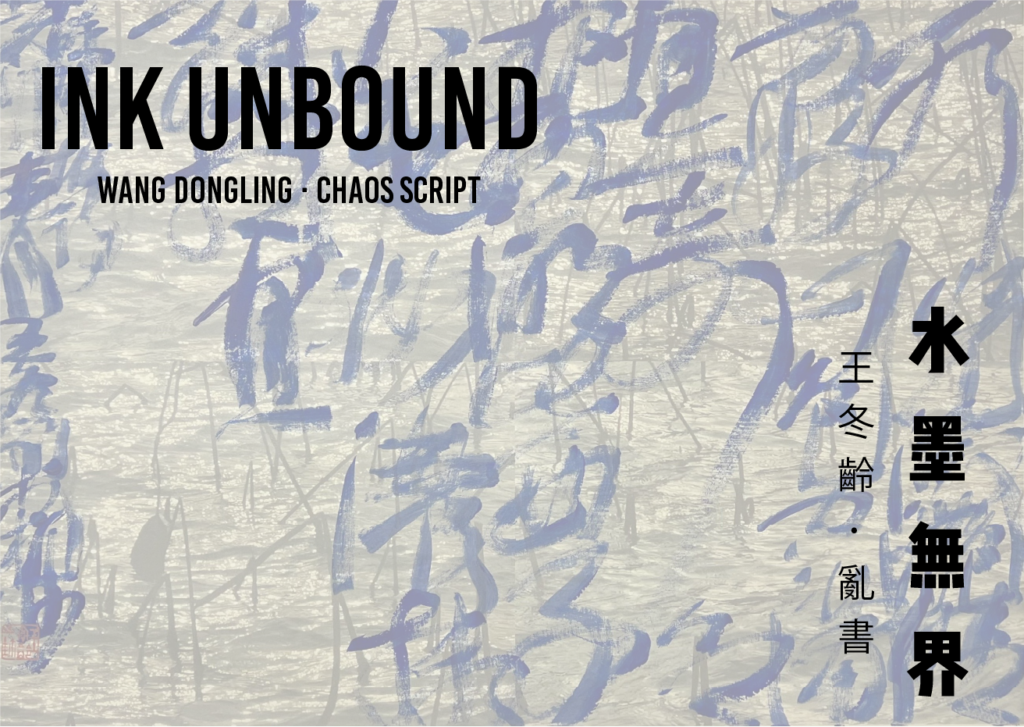

In works such as Lao Tzu – Tao Te Ching: The Principles of Naturalism (2018), Wang Dongling reinterprets the Tao Te Ching into a visual field shaped by flux and emergence, where ink gathers and disperses to evoke the formless, generative qualities of the Tao. In Li Bai – Farewell at Jingmen Ferry (2019), he reinterprets themes of departure and emotional distance from Tang Dynasty poetry through asymmetrical compositions of dense and open ink fields, where rhythm and brushwork evoke a melancholic sense of longing. In later works such as Su Shi – When It is Clear, the Ripples Gleam on This Beautiful Lake (2023), Wang incorporates photography, layering calligraphic gesture over images of West Lake to create a dialogue between text, image, and environment, foregrounding shifting perceptions of clarity and obscurity, permanence and ephemerality.
Through ink, gesture, and performance, Ink Unbound proposes Wang’s chaotic script as a living, embodied practice, one that continuously reactivates tradition through experimentation, spontaneity, and transformation.
Exhibition Overview
Born in Rudong, Jiangsu Province, Wang Dongling (b. 1945, China) is widely regarded globally as one of the most significant figures in contemporary ink practice. Wang received his undergraduate training at Nanjing Normal University in 1966, before completing a Master’s degree at the Calligraphy Department of the China Academy of Art — formerly Zhejiang Academy of Fine Art — in 1981. Wang currently serves as Professor at the China Academy of Art, where he supervises doctoral candidates and directs the Contemporary Calligraphy Research Centre, playing a pivotal role in shaping both pedagogical frameworks and critical discourse surrounding experimental calligraphy in China and beyond.
Wang Dongling was invited to participate in the 61st Venice Biennale’s China Pavilion, titled Dream Stream, which runs from 9 May to 22 November 2026. The exhibition showcased Wang’s monumental chaotic script, measuring 6.5 meters by 16.5 meters.

消遙遊 Free and Easy Wandering, 2026, 6.5×16.5m, Ink on Paper
Image Copyright: © China Academy of Art
Photographer: 唐經志
As part of Beyond Ink: New Horizons in Contemporary Chinese Calligraphy, Wang did a live performance of chapters 1 and 25 of the Tao Te Ching in chaotic script, measuring 2 meters by 5 meters. The exhibition will be held at the Bologna Museum in Italy from 7 May to 5 July 2026.


iPreciation is pleased to present Ink Unbound – Wang Dongling · Chaos Script. The exhibition’s theme originates from Wang’s rich creative practice and his diverse experiences that transcend national borders, paying tribute to Wang’s reimagining of traditional calligraphy with his signature chaotic script.
Grounded in the discipline of classical Chinese calligraphy — not limited to seal script, regular script, and official script — Wang studied under influential masters including Shen Zishan and Lin Sanzhi. Their rigorous instruction instilled in him not only technical precision but also a philosophical understanding of calligraphy as an embodied practice rooted in temporality, discipline, and spontaneity.
Wang extends from this lineage, eventually developing his signature chaotic script. This style he pioneered retains structural integrity while loosening formal constraints, opening calligraphy into an expanded field of gestural intensity, spatial dynamism, and improvisational freedom.
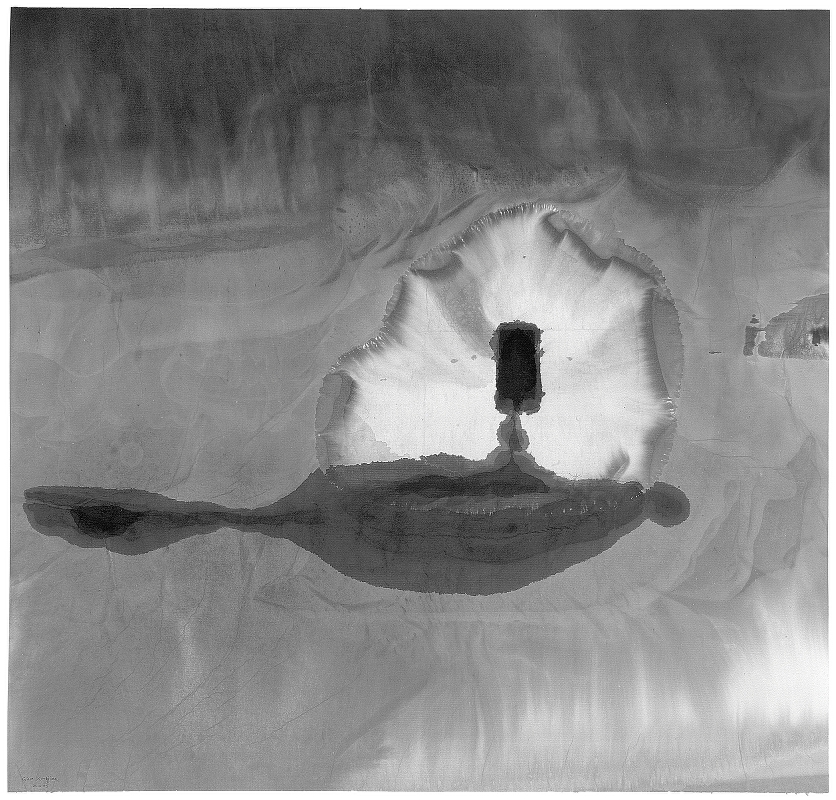
Central to Wang’s contemporary relevance is his reconfiguration of calligraphy as a visual and phenomenological system rather than a strictly linguistic one. His chaotic script resists stable legibility, unfolding instead as a field of energy in which ink disperses, accumulates, and collides across the surface. Meaning emerges through rhythm, density, and spatial tension, inviting viewers into an active process of perception.
In this sense, Wang’s work aligns with broader conceptual shifts in contemporary art that privilege experience over interpretation, process over fixed meaning. The dissolution of boundaries between text and image, reading and seeing, is further intensified in his works, where calligraphy becomes a durational, immersive act that extends beyond the confines of the page into lived, embodied experiences.
Wang’s chaotic script pioneered an entirely new art form in the realm of contemporary ink art, reflecting ancient wisdom and philosophies tied to Chinese intellectual traditions. Influences from Daoist spontaneity and Zen Buddhist notions of intuition and immediacy are evident in his embrace of improvisation and the relinquishing of rigid control. Rather than viewing chaos as the absence of structure, Wang frames it as a higher form of harmony — an echo of the Daoist idea that apparent disorder can embody a deeper, natural order. In this sense, his chaotic script becomes a visual manifestation of qi (i.e. vital energy), capturing Wang’s state of mind in the moment of creation.
Wang Dongling’s chaotic script contain within them ancient Chinese wisdom and poetry. Through his unique expressive style, Wang expresses reverence for the ancients and engages in dialogue with them. His works have the potential to ignite the viewer’s curiosity, leading them to a deeper appreciation of Chinese culture, revealing that these are not merely abstract works for their own sake. Wang’s works deserve further in-depth understanding and study from our generation!
About the Artist
Wang Dongling (b. 1945, Jiangsu, China) is a world-renowned leading contemporary ink artist, best known for large-scale performances of “wild cursive” chaotic script, characterized by their dynamic and erratic strokes. His works are deeply rooted in ancient Buddhist and Daoist thought, as well as classical Chinese literati poetry. Wang received his Bachelors from the Nanjing Normal University (Nanjing, China) in 1966 and his Masters from the Calligraphy Department of the Zhejiang Academy of Fine Arts (Hangzhou, China) in 1981.
Wang’s works have been prominently exhibited at prestigious institutions worldwide, including Cambridge University (Cambridge, UK), the Metropolitan Museum of Art (New York City, USA), Guggenheim Museum (New York City, USA), National Art Museum of China (Beijing, China), the Palace Museum (Beijing, China) and Asia Society Museum (New York City, USA). They can also be found amongst others in the collections of the British Museum (London, UK), Hong Kong Museum of Art (Hong Kong), the Art Institute of Chicago (Chicago, USA), the Zhejiang Museum of Fine Art, (Hangzhou, China), the Yale University Art Gallery (New Haven, USA), Harvard University (Cambridge, USA), and the University of California, Berkley (Berkley, USA).
Presented by iPreciation, a Singapore art gallery specialising in contemporary Asian art.