About Ah leon
Ah Leon is widely recognised as one of Taiwan’s most accomplished ceramic artists. In particular, he is known for transforming clay into highly realistic forms that challenge perception. As a result, his works blur the boundary between material and illusion.
At the same time, his practice bridges traditional craftsmanship and contemporary conceptual art. Therefore, his work continues to engage audiences across cultures and contexts.
Early Life and Training
Born in 1953 in Taiwan, Ah Leon began his formal education at the National Taiwan Academy of Arts, where he graduated in 1976. He later apprenticed with master potters across Taiwan between 1978 and 1982. Through this hands-on experience, he developed a deep understanding of ceramic techniques and material processes.
In addition, he participated in an artist-in-residence programme in the United States in 1982. This exposure broadened his artistic perspective and introduced new approaches to sculpture and installation. Consequently, his work began to move beyond tradition while still retaining its technical foundation.
Artistic Practice and Concept
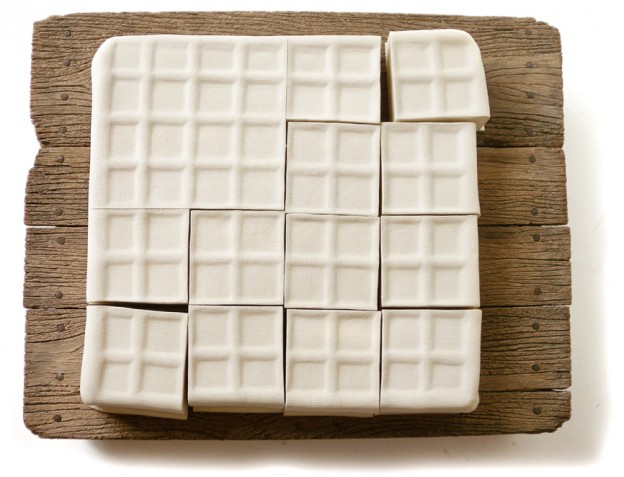
Ah Leon’s work is often described as trompe l’oeil, a technique that creates an illusion of reality. However, rather than using paint, he achieves this effect through clay. For instance, he replicates materials such as wood and tofu with remarkable precision. As a result, viewers often question what they are seeing.
Moreover, this contrast between appearance and material creates a unique sensory experience. While the surface suggests softness or organic texture, the object remains ceramic. Therefore, his works operate between realism and fabrication.
In many cases, this visual deception introduces an element of humour and surprise. At the same time, it encourages viewers to reconsider their assumptions about materiality and perception.
Illusion and Material Transformation
A defining feature of Ah Leon’s practice is his ability to manipulate clay into convincing imitations. For example, his ceramic “wood” structures replicate grain, texture, and age with extraordinary detail. Similarly, his tofu-like forms convey softness despite their solid composition.
Because of this transformation, his works challenge the viewer’s sense of touch and sight. In other words, what appears familiar becomes unfamiliar upon closer inspection. Consequently, the experience becomes both visual and conceptual.
Furthermore, this approach connects to broader ideas of memory and perception. As a result, his works often evoke recognition while simultaneously disrupting it.
Exhibitions and International Presence
Since the mid-1980s, Ah Leon has exhibited extensively across Asia, Europe, and the United States. His works have been shown in major institutions, including the National Palace Museum in Taipei and the Phoenix Art Museum in Arizona. In addition, exhibitions at the American Museum of Ceramic Art and other international venues have reinforced his global presence.
Notably, his large-scale installations, such as bridge-like ceramic structures, have demonstrated both technical mastery and conceptual ambition. As a result, his exhibitions often create immersive environments rather than isolated objects.
Collections and Recognition
Ah Leon’s works are held in prominent museum collections worldwide. These include the Arthur M. Sackler Gallery of the Smithsonian Institution, the Museum of Arts and Design in New York, and the Metropolitan Museum of Art. In addition, his works are part of major collections in Taiwan and other regions.
Because of this institutional recognition, his work has gained both critical and historical significance. Moreover, his continued presence in exhibitions highlights his relevance within contemporary ceramic practice.
Legacy and Impact
Beyond technical skill, Ah Leon’s contribution lies in redefining the possibilities of ceramics. Instead of treating clay as a purely functional or decorative medium, he transforms it into a conceptual tool. Consequently, his work expands how ceramics are understood within contemporary art.
At the same time, his practice reflects a dialogue between tradition and innovation. While rooted in classical training, it consistently evolves through experimentation. Therefore, his work continues to influence both artists and audiences internationally.
Education
- 1978 – 1982 | Apprenticed with Master Potters, Taiwan
- 1976 | Graduated from Taiwan National Academy of Arts, Taiwan
Selected Solo Exhibitions
- 2010 | ‘UN · Earth’ – A Cross-Cultural Ceramics Showcase, iPreciation, Hong Kong
- 2010 | American Museum Of Ceramic Art , LA, CA, USA
- 2009 | Phoenix Art Museum, Phoenix, AZ, USA
- 2004 | Crocker Art Museum, Sacramento, CA, USA
Selected Group Exhibitions
- 2000 | Selections from the Allan Chasanoff Ceramic Collection, Mint Museum of Art, Charlotte, NC, USA
- 2002 | Four Excellent Ceramists in Taiwan, National Museum of History, Taipei, Taiwan
Selected Public Collections
- 2010 | American Museum Of Ceramic Art , CA, USA
- 2010 | Taipei County Hakka Museum, Taipei, Taiwan
- 2010 | Museum of Fine Arts, Houston, TX, USA
- 2009 | Museum of Arts and Design, NY, USA
- 2003 | Asian Art Museum San Francisco. CA, USA
- 2003 | Johnson Museum of Art, NY, USA
- 2003 | Racine Art Museum, Racine, Wisconsin, USA
- 2002 | National Museum of History, Taipei, Taiwan
- 2001 | Ichon Ceramics Museum, Ichon, Korea
- 2001 | Taipei County Yingko Ceramics Museum, Taiwan
For full list of exhibitions and collections, please contact the gallery at enquiry@ipreciation.com
Images of artworks